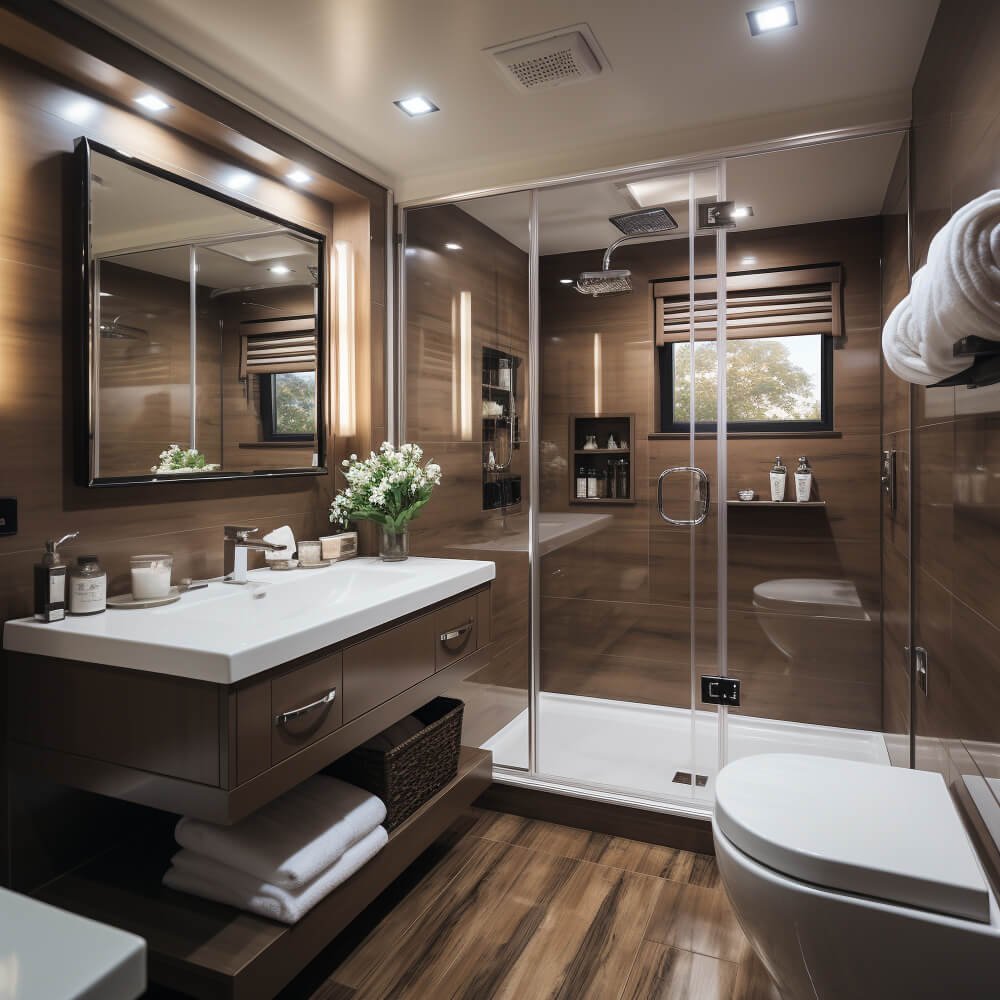

"My mom can barely step over the tub edge anymore, but she refuses to move to assisted living." This is the conversation I have with adult children across Hialeah almost weekly. The solution isn't moving—it's adapting the home to support safe aging-in-place, starting with the bathroom.
Barrier-free shower installation for aging-in-place in Hialeah costs $9,500 to $18,000 for complete curbless showers with safety features including zero-threshold entry, non-slip flooring, grab bars, built-in seating, and handheld shower wands. Most South Florida homeowners spend $11,500-$14,500 for quality installations meeting ADA guidelines and Florida building codes. After designing accessible bathrooms across Miami Gardens, Pembroke Pines, and Hollywood, I can show you exactly what creates safe, dignified bathing spaces that allow seniors to remain independent in their homes.
Understanding Barrier-Free Showers for Aging-in-Place
Let's clarify what makes a shower truly barrier-free and why it matters for senior safety.
What Is a Barrier-Free Shower?
Key characteristics:
- Zero threshold: Absolutely no step, curb, or lip (completely level entry)
- Flush with bathroom floor: Wheelchair can roll directly in
- Proper drainage slope: Floor slopes gently to drain without creating trip hazard
- Wide entry: Minimum 32-36" opening (wheelchair accessible)
- Safety features: Grab bars, seating, non-slip surfaces
Not barrier-free:
- Low curb showers (2-3" threshold—still requires step-over)
- Standard walk-in showers (4-6" curb)
- Showers with any lip or edge at entry
True barrier-free design means someone using a walker, wheelchair, or having balance issues can enter the shower without stepping over anything.
Why Barrier-Free Showers Matter for Aging-in-Place
Falls are the leading cause of injury for seniors—and the statistics are sobering:
- •1 in 4 Americans 65+ fall each year according to CDC data
- •Bathrooms account for 80% of fall-related injuries—making them the most dangerous room in the home
- •Stepping over tub edges creates the highest fall risk for seniors
- •Wet, slippery surfaces compound the danger exponentially
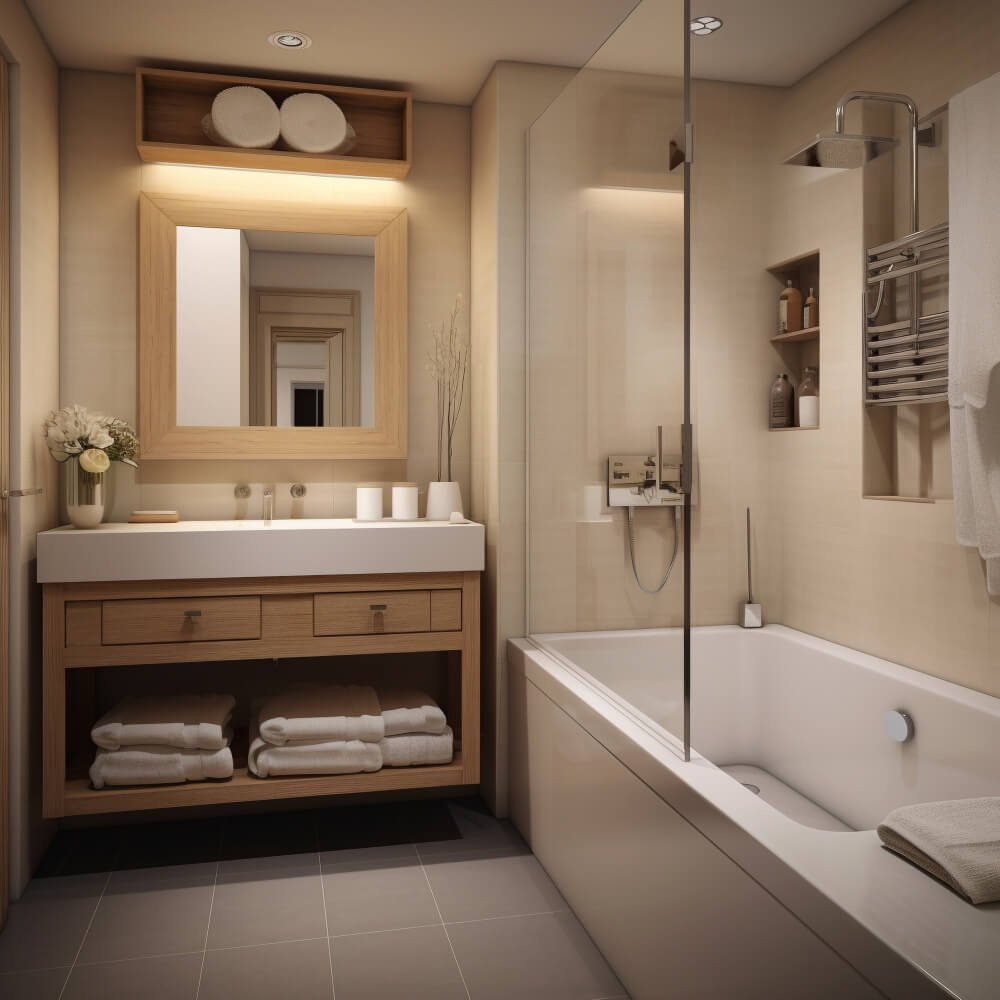
Barrier-free showers dramatically reduce fall risk through multiple safety layers:
- ✓Eliminating step-over requirement—the primary fall cause is completely removed
- ✓Providing grab bars for stability—strategically placed for maximum support
- ✓Including seating to shower while seated—no need to stand during bathing
- ✓Using non-slip flooring throughout—textured surfaces prevent slips even when wet
- ✓Creating clear, unobstructed path—wheelchair accessible and easy navigation
A Pembroke Pines family installed a barrier-free shower for their 78-year-old mother after a close call stepping out of her old tub. "She uses the grab bars and shower seat every day. We all sleep better knowing she's safe," her daughter told me.
Universal Design: Benefits Beyond Aging
Barrier-free showers follow universal design principles—accessible to people of all ages and abilities.
Universal design benefits extend far beyond seniors—here's who gains from barrier-free showers:
Primary audience seeking safe, independent living
Temporary or permanent mobility needs
Knee, hip replacements, and other procedures
Easier bathing for kids and parents
Universal design doesn't look "medical" or institutional. Modern barrier-free showers are beautiful, spa-like spaces that happen to be accessible. They add home value and appeal to growing demographic of aging baby boomers.
Barrier-Free Shower Cost Breakdown
Let's examine what you'll invest at different levels of accessibility and quality.
Basic Barrier-Free Conversion: $9,500 - $12,500
Essential accessibility features without luxury finishes.
Here's exactly what's included in a basic barrier-free conversion:
Timeline: 6-9 days
Best for: Budget-conscious accessibility improvements, functional priority over aesthetics
This range delivers genuine accessibility and safety without premium materials or finishes.
Standard Barrier-Free Installation: $13,000 - $16,000
Balance of accessibility, safety, and aesthetic appeal.
Standard installations elevate both safety and aesthetics—here's what you get:
Timeline: 8-12 days
Best for: Primary residences, long-term aging-in-place planning, balance of safety and aesthetics
This range creates beautiful, accessible showers that don't look institutional while meeting all safety requirements.
Premium Accessible Shower: $17,000 - $25,000+
Spa-like experience with comprehensive accessibility features.
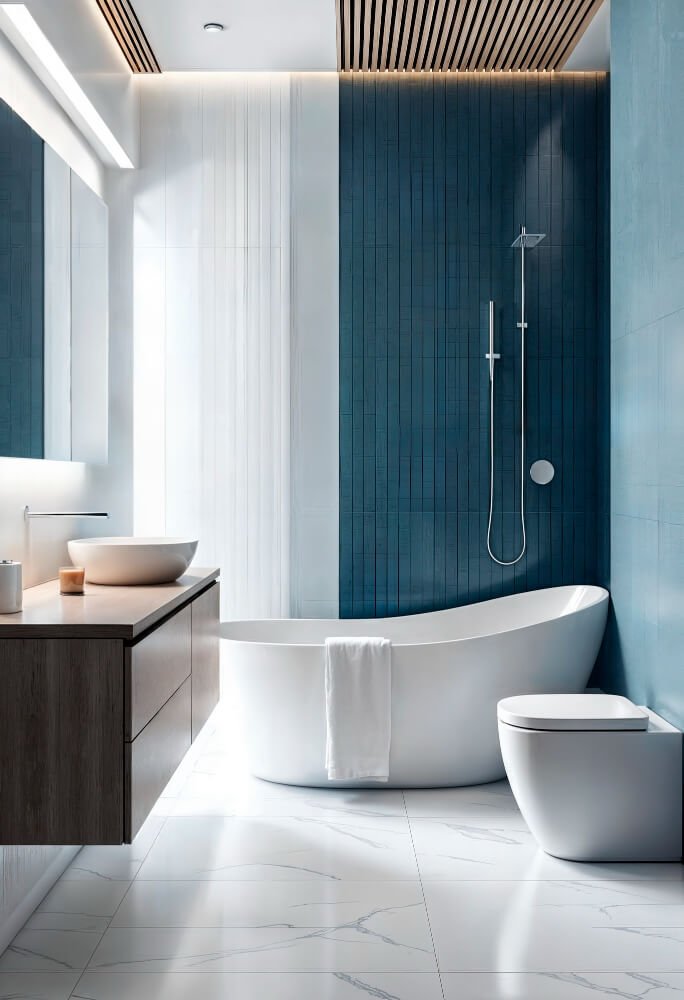
What's included:
- Expert demo and preparation: $1,000-$1,500
- Precision floor lowering with reinforcement: $2,500-$4,000
- Premium linear drain (stainless, designer grate): $600-$1,200
- Complete waterproofing system: $1,200-$2,000
- Large-format porcelain or stone-look tile: $3,500-$6,000
- Custom tile work with accent features: $3,500-$6,000
- Multiple designer grab bars (5-6, match fixtures): $500-$1,000
- Custom built-in bench with tile finish: $900-$1,800
- Thermostatic digital shower system: $800-$1,500
- Multiple showerheads with easy controls: $600-$1,200
- Frameless glass partial enclosure: $1,500-$2,500
- Luxury non-slip flooring with heat: $2,000-$3,500
- Accessible lighting system: $400-$800
- Complete custom plumbing and electrical: $1,800-$3,000
- Premium installation and finishing: $3,000-$5,000
- Engineering, permits, inspections: $1,000-$1,800
Timeline: 10-15 days
Best for: High-value homes, luxury aging-in-place, homeowners wanting spa experience with accessibility
A Coral Springs client in a $620,000 home created a stunning barrier-free master shower for $19,200. It looks like a luxury spa while providing complete accessibility with grab bars, built-in bench, and zero threshold. She plans to remain in her home for 20+ years, making this an excellent long-term investment.
Essential Features of Barrier-Free Showers
Specific elements create truly accessible, safe bathing spaces.
Zero-Threshold Entry (Most Critical Feature)
Creating a true zero-threshold entry requires careful engineering:
-
🔧
Floor lowering:
3-4" minimum depth required to create proper drainage slope—this is the foundation of barrier-free design
-
💧
Linear drain:
Long, narrow drain (typically 24-36") strategically positioned to handle water from the sloped floor efficiently
-
🛡️
Extended waterproofing:
Critical barrier system prevents water from escaping into the bathroom—extends well beyond the shower area
-
📐
Proper slope:
1/4" per foot minimum toward drain ensures water flows correctly without creating trip hazards
Why it's expensive (+$2,000-$4,000 vs. standard curbed shower):
- Breaking and removing existing floor
- Creating new sloped mortar bed
- Installing specialized drain system
- Enhanced waterproofing beyond shower area
- Potential floor joist modifications for depth
- Transition threshold to rest of bathroom floor
South Florida consideration: Curbless showers require meticulous waterproofing in our humid climate. Water containment is more challenging without curb, making professional installation essential.
Linear drain placement options:
- Against back wall (most common, water flows back)
- Center of shower (360-degree slope, more complex)
- Along one side (efficient for narrow showers)
A Miami Gardens client initially balked at the $3,200 cost for zero-threshold design. After installation, her 82-year-old mother with walker uses the shower confidently. "The money is irrelevant compared to her safety and independence," she told me.
Grab Bars (Safety Foundation)
Strategic grab bar placement creates a safety network throughout the shower:
-
🚪
Entry area:
Vertical grab bar at entry (36-42" high) provides crucial support when entering and exiting—the most vulnerable moment
-
🚿
Showerhead wall:
Horizontal grab bar (33-36" high) offers stability while showering standing—perfect height for natural hand placement
-
🪑
Seat area:
Horizontal grab bar (33-36" high) assists with sitting and standing from the seat—critical for safe transitions
-
🔗
Multiple support points:
Additional bars create a continuous support path—never more than an arm's reach from stability
Quality requirements:
- Must support minimum 250 lbs per ADA standards
- Require blocking behind tile (installed during construction)
- Stainless steel or brass (rust-resistant in humid climate)
- Textured grip surface
- Proper installation with structural screws into blocking (not just into drywall)
Aesthetic options:
- Match fixture finish (brushed nickel, matte black, chrome)
- Designer styles that look like towel bars
- Decorative options that don't appear "medical"
Cost: $50-$150 per grab bar installed (including blocking during construction)
Common mistake: Installing cheap grab bars with hollow wall anchors. These fail under actual fall conditions. Proper blocking and installation is non-negotiable for safety.
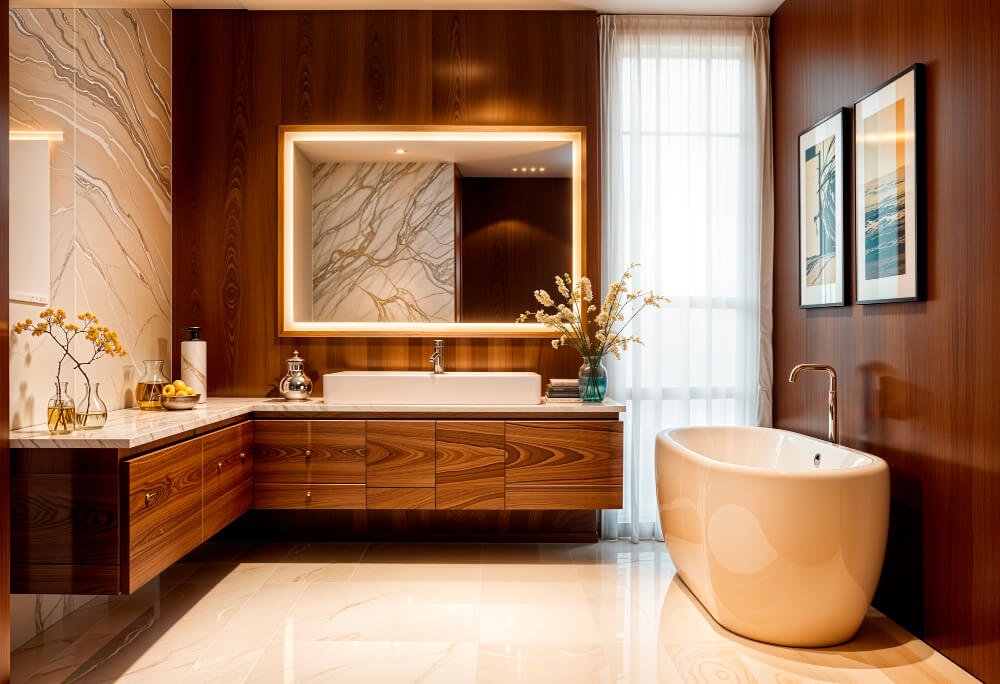
Non-Slip Flooring
Requirements:
- High slip-resistance rating (minimum 0.42 coefficient of friction)
- Comfortable underfoot (not excessively textured)
- Proper drainage slope maintained
- Easy to clean (grout lines shouldn't trap dirt/mold)
Best options for Hialeah barrier-free showers:
Porcelain tile with textured finish:
- ✓ Excellent slip resistance when wet
- ✓ Durable and long-lasting
- ✓ Various sizes and colors
- ✓ Easy maintenance
Pebble tile:
- ✓ Natural slip resistance (texture from stone shapes)
- ✓ Comfortable underfoot
- ✓ Spa-like appearance
- ✗ More grout lines (requires more maintenance)
Large-format tile (12"x24"+):
- ✓ Fewer grout lines (easier cleaning)
- ✓ Modern appearance
- ✓ Must have textured or matte finish (not polished)
- ✓ Good balance of safety and aesthetics
Avoid for shower floors:
- Polished stone or tile (extremely slippery when wet)
- Smooth ceramic tile
- Glass tile
- Any high-gloss finish
Cost: $8-$18 per sq ft installed for quality non-slip tile
Seating Options
| Seating Type | Pros | Cons | Best For | Cost |
|---|---|---|---|---|
| Built-in tile bench | Attractive, integrated, tile matches shower | Cold surface, more expensive, permanent | Permanent installations, primary bathrooms | $600-$1,200 |
| Fold-down seat | Folds away, saves space | Mechanical parts can fail, less attractive | Smaller showers, multiple users | $300-$600 |
| Portable shower chair | Lowest cost, adjustable height, removable | Least attractive, must be stored, can slide | Temporary needs, budget projects | $100-$400 |
| Wheelchair transfer bench | Safe wheelchair transfer, adjustable | Extends outside shower, requires storage | Full wheelchair users | $150-$500 |
Recommendation: For permanent aging-in-place installations, built-in tile benches deliver best combination of safety, comfort, and aesthetics. For temporary or budget-conscious projects, quality fold-down seats work well.
Handheld Shower Wand (Essential Feature)
Why it's critical for accessibility:
- Allows showering while seated
- User controls where water sprays
- Easier to rinse thoroughly
- Assists with personal hygiene
- Can be used from various positions
Features to prioritize:
- Long hose (5-7 feet minimum)
- Easy-grip handle (large enough for arthritic hands)
- Simple controls (single button or lever)
- Adjustable height slide bar
- Anti-scald technology (maintains temperature)
Installation height:
- Slide bar: 38-48" above floor (allows adjustment up/down)
- Can be removed from slide bar and used handheld
- Should be reachable from seated position
Cost: $200-$600 for quality system installed
Pro tip: Install both handheld wand AND fixed showerhead. Family members without mobility limitations appreciate standing shower experience, while senior uses handheld wand while seated.
Accessible Controls
Placement requirements:
- Located 38-48" above floor (reachable from seated position)
- Within easy reach (don't require stretching across shower)
- Outside shower spray zone (can adjust without getting wet)
- Single-lever or large controls (easy for arthritis)
Thermostatic valve ($400-$800):
- Maintains precise temperature (prevents scalding)
- Separate volume and temperature controls
- Critical safety feature for seniors
A Hollywood client's father with dementia accidentally turned water to full hot in his old shower and suffered minor burns. After installing thermostatic valve, water temperature stays consistent—he can't accidentally scald himself. Safety features provide peace of mind for entire family.
Adequate Lighting
Requirements:
- Waterproof recessed fixtures
- Bright enough for good visibility (seniors need more light)
- Easy controls (accessible switch location)
- Night-light option (low-level illumination for safety)
Recommended lighting:
- 2-3 recessed LED fixtures in shower ceiling
- Dimmer switch (adjustable brightness)
- Motion-activated night light in bathroom
- No shadows creating trip hazards
Cost: $200-$600 for dedicated shower lighting installed
Planning Your Barrier-Free Shower
Strategic decisions during planning create the safest, most functional accessible bathroom.
Size and Layout Considerations
Minimum dimensions for basic accessibility:
- 36"x60" interior space (ADA minimum for wheelchair access)
- 32-36" clear entry width
- Turning radius for wheelchair (60" diameter circle)
Recommended dimensions for comfortable use:
- 48"x60" or larger (more comfortable movement)
- 36" clear entry (easier access)
- Built-in bench doesn't obstruct turning radius
Optimal layout:
- Entry on longest wall (easiest access)
- Bench on opposite wall from entry
- Handheld wand centered for reach from seat
- Grab bars create continuous support path
Small bathroom challenges:
- May require reducing vanity size to accommodate larger shower
- Consider pocket door or removing door entirely (more clearance)
- Every inch matters in accessibility
A Miramar client's 5'x8' bathroom seemed too small for barrier-free shower. By reducing vanity from 48" to 36" and installing pocket door, we created 48"x54" accessible shower with all safety features. Sometimes creative layout solves space constraints.
Structural Considerations
Floor lowering requirements:
- Must lower floor 3-4" to create proper drainage slope
- May require modifying floor joists
- Need adequate depth below bathroom floor
- Slab-on-grade construction more challenging (requires breaking slab)
Engineering assessment ($300-$800):
- Determines if floor structure supports modifications
- Specifies required reinforcement
- Ensures proper drainage slope achievable
- Required for permit approval
Potential complications:
- Plumbing below floor interferes with lowering
- Floor joists insufficient depth (need sistering or reinforcement)
- Slab-on-grade requires extensive concrete work
- Structural modifications needed for support
Don't skip engineering assessment. Attempting curbless shower without proper structural evaluation creates unsafe conditions and code violations.
Waterproofing in Curbless Showers
Extended waterproofing required:
- Shower floor obviously needs waterproofing
- Must extend waterproofing beyond shower area into bathroom
- Typically extend 12-24" past shower opening
- All transition areas fully sealed
Best systems for South Florida:
- Schluter Kerdi system (comprehensive waterproofing)
- RedGard liquid membrane
- Hot-mop traditional method
- All meet code when installed correctly
Critical details:
- Linear drain must integrate properly with waterproofing
- All corners and transitions fully sealed
- Floor slope must be consistent (no low spots where water pools)
- Test flooding for 24-48 hours before tile installation
Cost: $1,000-$2,000 for proper curbless shower waterproofing (more extensive than curbed showers)
Waterproofing mistakes in curbless showers are expensive—water can escape into bathroom and underlying structure, creating mold and rot. This is NOT the place to cut costs.
Choosing Tile and Finishes
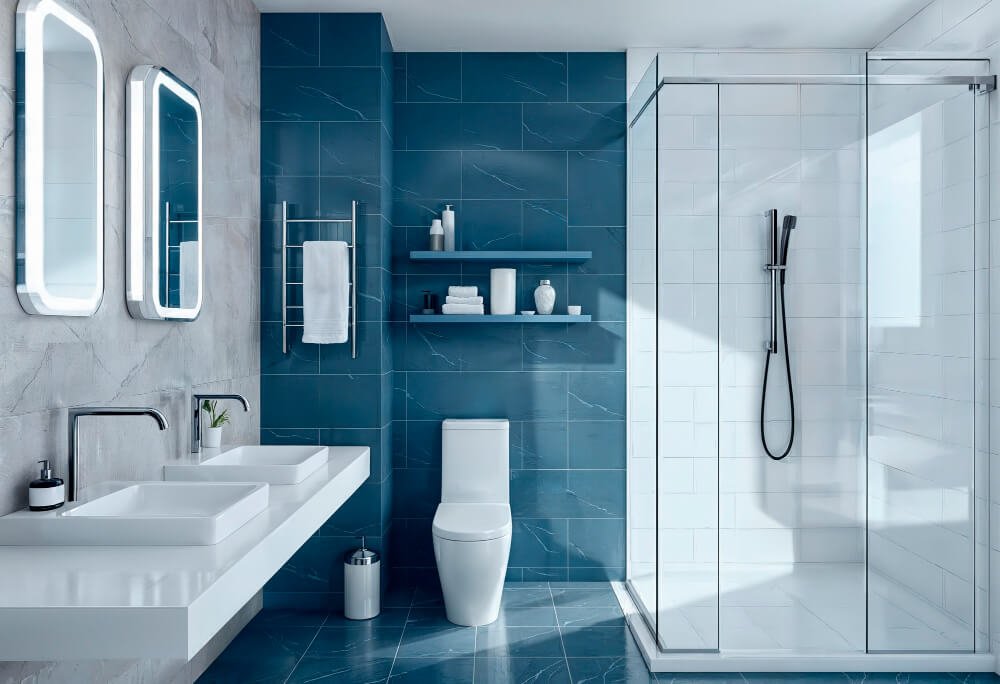
Floor tile priority: Safety over appearance
- Slip-resistance is non-negotiable
- Larger tiles preferred (fewer grout lines to maintain)
- Matte or textured finish required
- Neutral colors hide water staining better
Wall tile: Can prioritize aesthetics (less slip concern)
- Large-format tile creates modern appearance
- Lighter colors make shower feel more spacious
- Easy-to-clean surfaces important
Grout selection:
- Epoxy grout (no sealing required, mildew-resistant): $2-$4/sq ft premium
- High-quality cement grout with sealer: Standard option
- Medium-gray color (hides water staining better than white)
Accent tile:
- Use sparingly (creates visual interest without overwhelming)
- Niche areas good for accent
- Avoid slippery materials on floor
Integrating Grab Bars into Design
Make grab bars intentional design elements:
- Match fixture finishes (creates cohesive appearance)
- Choose styles that complement overall design
- Consider decorative options that don't look institutional
- Install sufficient quantity for genuine safety (don't skimp)
Blocking placement:
- Install wood blocking behind all walls during construction
- Standard placement plus custom locations based on user needs
- Over-block if uncertain (better than not enough)
- Costs almost nothing during construction, expensive to add later
Future flexibility:
- Block for potential grab bar locations even if not installing immediately
- Allows adding grab bars later without opening walls
- Small upfront investment provides valuable flexibility
Medicare and Insurance Coverage for Barrier-Free Showers
Understanding funding options reduces financial burden.
What Medicare Covers (Usually Limited)
Medicare Part B:
- Covers durable medical equipment (DME)
- May cover portable shower chairs, benches, commodes
- Does NOT typically cover home modifications (installation)
Reality: Medicare rarely covers barrier-free shower installation costs. It may cover individual DME items but not construction.
What Medicare Advantage Plans May Cover
Some Medicare Advantage plans include:
- Home safety modifications (limited amounts)
- $500-$2,000 annual allowance for accessibility improvements
- Varies dramatically by plan and state
Check your specific plan's "supplemental benefits" for home modification coverage.
Medicaid and State Programs
Florida Medicaid:
- May cover home modifications through waiver programs
- Typically requires demonstrating medical necessity
- Income and asset limitations apply
- Process can take 3-6 months
Area Agency on Aging:
- Some grants available for home modifications
- Income-based eligibility
- Limited funding (waitlists common)
Veterans Affairs (VA) Benefits
VA Home Improvement and Structural Alterations (HISA) Grant:
- Up to $6,800 for service-connected disabilities
- Up to $2,000 for non-service-connected disabilities
- Covers medically necessary home modifications
- Requires VA approval before starting work
Specially Adapted Housing (SAH) Grant:
- Up to $100,896 for severely disabled veterans
- Covers major home modifications
- Strict eligibility requirements
Process: Apply through VA before beginning work. Pre-approval required or you won't receive funding.
Private Insurance
Long-term care insurance:
- Some policies include home modification benefits
- Check policy for "home care benefits"
- May cover portion of accessibility improvements
Homeowners insurance: Does NOT typically cover accessibility improvements (not damage-related)
Tax Deductions
Medical expense deduction:
- Home modifications prescribed by doctor may qualify
- Must exceed 7.5% of adjusted gross income
- Consult tax professional for your situation
- Keep all receipts and medical documentation
Funding Strategies for Hialeah Homeowners
Realistic funding approaches:
1. Personal savings or HELOC (most common)
- • Most homeowners self-fund improvements
- • HELOC rates: 7-10% in Florida
- • Interest may be tax-deductible
2. Family cost-sharing
- • Adult children often contribute to parents' aging-in-place modifications
- • Cheaper than assisted living ($4,000-$8,000/month)
- • Keeps family together
3. Grants and assistance programs
- • Rebuilding Together (local chapters offer assistance)
- • Habitat for Humanity (some locations offer accessibility mods)
- • Local charities and foundations
4. Phased approach
- • Install grab bars and handheld wand now ($500-$1,000)
- • Add fold-down seat later ($300-$600)
- • Full barrier-free conversion when budget allows
A Pembroke Pines family contributed $8,000 (split among three adult children) to convert their mother's bathroom to barrier-free design. "It's expensive, but it's one-tenth the cost of assisted living for even a single year. Mom stays in her home, and we have peace of mind."
Frequently Asked Questions: Barrier-Free Showers
Q: How much does a barrier-free shower cost in Hialeah?
A: $9,500-$18,000 for complete installations including zero threshold, grab bars, seating, and safety features. Most homeowners spend $11,500-$14,500 for quality accessible showers.
Q: Does removing my bathtub for barrier-free shower hurt home value?
A: Usually not, especially if:
- • You have another tub in the home
- • Your home has 2+ bathrooms
- • Installation is professionally done and attractive
- • Buyer demographic includes aging population (increasingly common)
In some cases, accessible features actually increase value for baby boomer buyers planning to age in place.
Q: What's the difference between barrier-free and wheelchair accessible?
A: Often used interchangeably, but technically:
- • Barrier-free: Zero threshold, may or may not meet full ADA requirements
- • Wheelchair accessible: Meets ADA requirements (36"x60" minimum, specific grab bar placement, etc.)
All wheelchair accessible showers are barrier-free, but not all barrier-free showers meet full ADA standards.
Q: Can I install a barrier-free shower in my mobile/manufactured home?
A: Possible but challenging:
- • Floor structure may not allow lowering for zero threshold
- • Structural modifications limited by construction type
- • May need alternative solutions (low-barrier vs. zero threshold)
- • Consult with contractor experienced in mobile home modifications
Q: How long does barrier-free shower installation take?
A: Typical timeline:
- • Planning and permits: 2-3 weeks
- • Demolition and structural work: 2-3 days
- • Floor lowering and waterproofing: 3-4 days
- • Tile installation: 3-5 days
- • Fixtures and final touches: 2-3 days
- • Total: 8-12 days from demo to completion
Q: Will my homeowners insurance cover aging-in-place modifications?
A: Typically no—homeowners insurance covers damage, not improvements or accessibility modifications. However, some insurers offer discounts for safety improvements like grab bars. Check with your carrier.
Q: What's the minimum shower size for aging-in-place?
A: Depends on mobility needs:
- • Aging in place (walker, standing with support): 48"x36" minimum recommended
- • Wheelchair user transferring to shower seat: 36"x60" ADA minimum
- • Wheelchair user showering in chair: 60"x60" or larger recommended
Larger is always better for accessibility—provides more maneuvering room and reduces fall risk.
Q: Should I install grab bars even if I don't need them now?
A: At minimum, install blocking (wood reinforcement behind tile) during construction. This costs $20-$50 per location but allows adding grab bars later without opening walls. Better yet, install grab bars during initial construction—they're attractive, useful for everyone (balance, support), and cost less to install during construction than adding later.
Making Your Decision: Creating a Safe Aging-in-Place Bathroom
Barrier-free showers allow seniors to maintain independence, dignity, and safety while aging in their Hialeah homes. The $11,500-$14,500 investment is significant but pales compared to assisted living costs ($48,000-$96,000 annually) or the physical and emotional cost of a fall-related injury.
Barrier-free shower makes sense if:
- ✓ Senior wants to remain in home long-term (5+ years)
- ✓ Mobility challenges make current bathing arrangement unsafe
- ✓ Family wants peace of mind about senior's safety
- ✓ Home modifications are more cost-effective than moving
- ✓ Senior is cognitively capable of living independently with support
Start planning when:
- ✓ Senior is still relatively healthy (proactive vs. reactive)
- ✓ Family can participate in planning and funding
- ✓ You have 3-6 months for proper planning and execution
- ✓ Other aging-in-place modifications being considered (coordinated approach)
For Hialeah, Pembroke Pines, Hollywood, and South Florida families, barrier-free showers are investments in safety, independence, and quality of life. They allow seniors to age gracefully in the homes they love, surrounded by the communities and memories they've built over decades.
Ready to Create a Safe, Accessible Bathroom?
Contact our expert team for a free consultation on barrier-free shower installation tailored to your needs.
Schedule Free Consultation